Every Evalingo result maps to the CEFR scale, the Common European Framework of Reference, which is the international standard for describing language ability. It runs across six levels.

Choosing a bar for your role

The most common mistake is setting the bar too high. B2 is enough for the large majority of customer-facing work. Requiring C1 when B2 would do shrinks your candidate pool sharply and rarely improves outcomes. A useful test: think of a current employee who does the job well. What level would they score? That is your bar.
Levels often differ between skills for the same person. Someone can write at C1 and speak at B1, or the reverse. If only one skill matters for the role, test only that one.

”Not assessable”

Sometimes a skill shows Not assessable instead of a level. That means the responses were not a genuine attempt: answered in the wrong language, off topic, left blank, or, for reading and listening, indistinguishable from random guessing or answered faster than the text could be read or the recording heard.
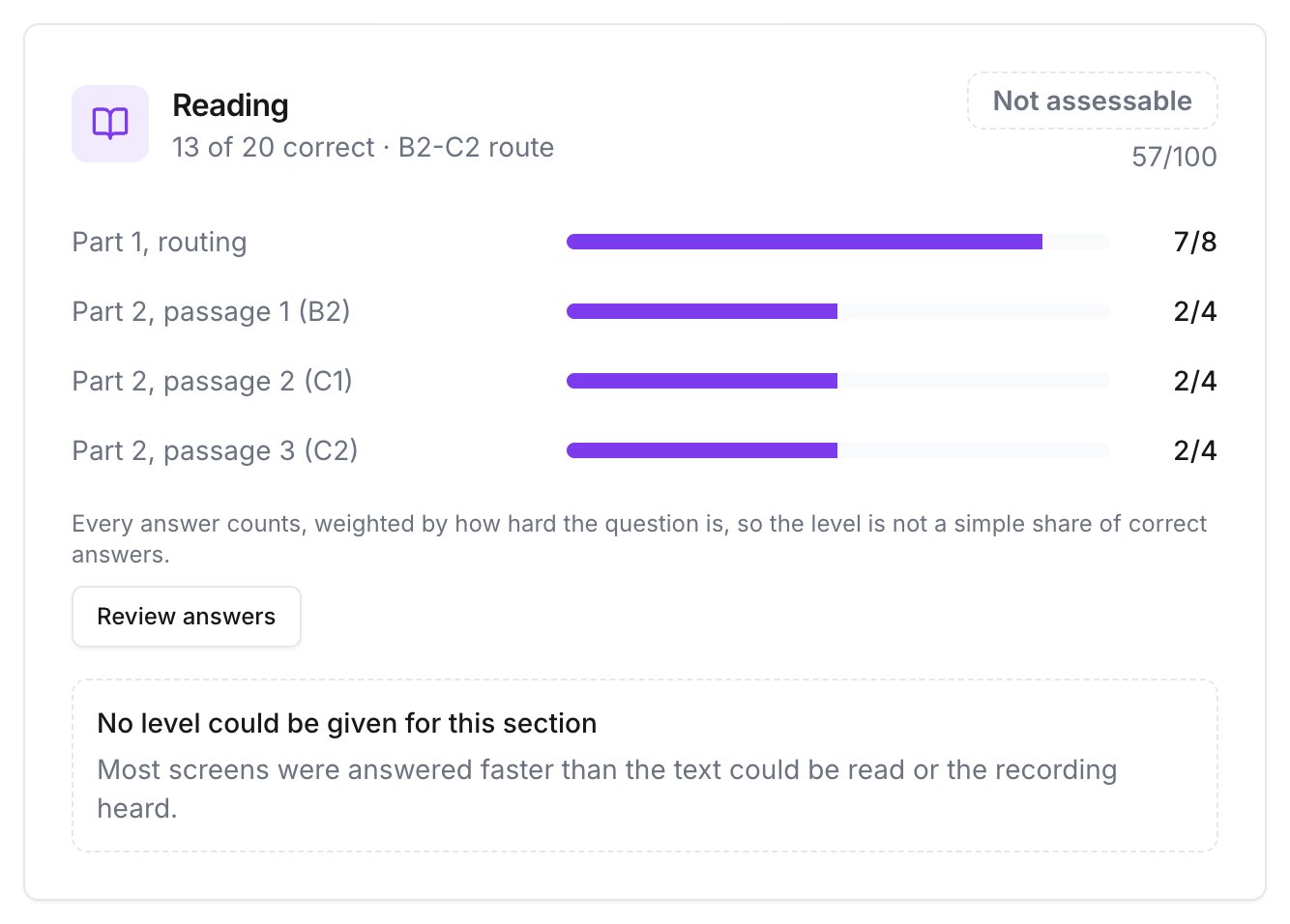
A Reading result marked Not assessable, with part-by-part scores and the note: most screens were answered faster than the text could be read or the recording heard

A reading section with no level given. The counts are still shown, and the reason is stated.

A1 is the bottom of the scale, so there is no lower band for a non-attempt to fall into. Rather than label it A1 and describe abilities the candidate never showed, we withhold the level and say why. The Responses tab shows the detail for each answer.